Tuesday, 20 April 2021

Being Raised with Him in Newness of Life

This is an extract from The Reformed Baptism Form: A Commentary (Jenison, MI: Reformed Free Publishing Association, 2016), by Reformed minister and theologian Bastiaan Wielenga (1873-1949). He was a fruit of the Afscheiding (Secession) of 1834 in the Netherlands, led by men such as Hendrik de Cock (1801–1842) and Simon van Velzen (1809-1896). His instructor and mentor was Herman Bavinck (1854–1921), whom Wielenga held in high esteem.

The section below is part of a commentary of the prayer found in the Reformed "Form for the Administration of Baptism," which says what follows.

O Almighty and eternal God, Thou who hast according to Thy severe judgment punished the unbelieving and unrepentant world with the flood, and hast according to Thy great mercy saved and protected believing Noah and his family; Thou who hast drowned the obstinate Pharaoh and his host in the Red Sea, and hast led Thy people Israel through the midst of the Sea upon dry ground, by which baptism was signified—we beseech Thee that Thou wilt be pleased, of Thine infinite mercy, graciously to look upon these children and incorporate them by Thy Holy Spirit into Thy Son Jesus Christ, that they may be buried with Him into His death, and be raised with Him in newness of life; that they may daily follow Him, joyfully bearing their cross, and cleave unto Him in true faith, firm hope, and ardent love; that they may, with a comfortable sense of Thy favor, leave this life, which is nothing but a continual death, and at the last day may appear without terror before the judgment seat of Christ Thy Son, through Jesus Christ our Lord, who with Thee and the Holy Ghost, one only God, lives and reigns forever. Amen.

More specifically, what follows is part of Wielenga's commentary to the part in bold.

_______________

Bastiaan Wielenga (1873-1949).
Source: https://bit.ly/3asMWhM

Note, this is the symbol of what grace does. It pulls the old down, so that the new may rise. Just as Christ’s death and burial did not have the purpose in themselves but were the way, the means to his glorious resurrection, so are the death and burial of the old man the way of preparation, the trailblazer to the resurrection of the new life.

What is this new life? In every respect it is the contrast to the old life. Everything that the old man, who goes down into the grave and is left behind, is in a negative sense, the new man, who gloriously arises from the grave, is in a positive sense. 

He no longer serves sin (Rom. 6:6). He is justified and freed from sin (v. 7). Death has no longer dominion over him (v. 9). Sin no longer reigns in his mortal body in order to obey it in the lusts of the same body (v. 12). He no longer yields his members as instruments of unrighteousness (v. 13). He has put off concerning the former conversation the old man, which is corrupt according to the deceitful lusts (Eph. 4:22). 

All this is the negative result. But that, as the reverse, brings with it a positive power and beauty and the blessedness of the new life. 

Listen to what the apostle says of the new life that by baptism is sealed and signified to God’s child. He who by baptism partakes of the resurrection of Christ may believe that he shall also live with him, that is, here the spiritual and thereafter eternal life (Rom. 6:8). For in that he lives, he lives for God (v. 10). He yields himself unto God (that is, he is subservient to God) as those who are alive from the dead and yields his members as instruments of righteousness to God (v. 13). He has obeyed from the heart that form of doctrine that was delivered to him (v. 17). He has become a servant of righteousness (v. 18). He has his fruit unto holiness, and the end everlasting life (v. 22). 

To summarize all of this: Christ has given himself for his people so that he may sanctify and cleanse them with the washing of water by the word, so that he might present them to himself a glorious body, not having spot, or wrinkle, or any such thing; but that it should be holy and without blemish (Eph. 5:26–27). 

Thus new is not used here in the form in the way of, for example, the expression “a new year,” where it means nothing but something that follows on, that has just begun; or also as the expression “a new book,” which indicates that it has not been used. No, when God is asked in this prayer for the resurrection of a new life, this means a completely different and changed life, a life totally and radically different from the former one. 

This kind of life comprises not just a part of man, but the whole of man: a new mind and a new heart; a new will and a new imagination; new emotions and a new consciousness. Everything must become new, in him and to him. Also the new body that will one day be raised from the grave as a perfect instrument of the renewed soul is the result of being baptized into the resurrection of Christ. 

If perhaps the question arises among us, why all this is asked separately for this child when it is already included in the incorporation into Christ, the answer is that life, also the new life, is not only God’s gift to man, but also a calling, a task of man. The Reformed declare themselves dead set against all fatalism, whether this is forced upon them from Islam or from a modern form of the philosophy of Spinoza. The Christian is not forced to live but actively lives life, when God ignites the spark of the new life in his soul. He walks, as Paul says in Romans 6, in newness of life. 

What would otherwise be the sense of the admonitions that he adds to the picture of that glorious renewed life? Why in verse 13 this: “Neither yield ye your members as instruments of unrighteousness unto sin: but yield yourselves unto God, as those that are alive from the dead, and your members as instruments of righteousness unto God.” 

Life is not letting oneself be swept along by the tide, simply awaiting those things that will happen. It is a battle, a pushing forward; a striving for development that comes to an end; and running the race that must find its end. It is not without reason that our marginal annotators at Romans 6:4 point to Hebrews 12:1, where we read, “Wherefore seeing we also are compassed about with so great a cloud of witnesses, let us lay aside every weight, and the sin which doth so easily beset us, and let us run with patience the race that is set before us.” 

Thus this prayer has its origin in the truth that the new life of God’s child is in itself perfect and spotlessly holy, but it needs to develop into full maturity. He must strongly resist the sin that is rampant and attacks man from within and without. The prayer to enable the Christian for life’s entire task and the whole of his calling is thus encapsulated in this petition, [So that it be] raised with him in newness of life

The congregation prays for the child that he later will live this new life, internally in the hidden relationship with God, but also externally in all walks of life in which God may give him a place—in the family; in the church; in his place of work; in society and in the country. It is the prayer that grace, sealed and promised by baptism, may spread its sphere of influence over all that the child is, thinks, wills, speaks, and does. Thus how meaningful is this prayer and how rich in content. 

But in order that this new man not regard himself for a moment capable to do all these things in his own power, the congregation adds the conclusive and most significant few words: with him! To be raised with Christ in newness of life is the prayer. Not only now, but always. Never without Christ. Always sharing in his resurrection. 

Outside the vine the shoot has no sap and does not bear fruit. Without a connection from moment to moment with the great power source, the platinum filament of the electric lamp refuses to glow. Without the root the plant is doomed to die. 

Only when we have become one plant with him in the likeness of his death, we shall be also in the likeness of his resurrection (Rom. 6:5). Christ can say of himself, “For as the Father hath life in himself; so hath he given to the Son to have life in himself” (John 5:26). But the glory of the Christian is, “Nevertheless I live; yet not I, but Christ liveth in me” (Gal. 2:20). 

...

One does not easily exhaust the thoughts of the prayer that the child be raised with him in newness of life. The resurrection of the new man is a process as of a budding flower that under the fertile dew unfolds its beauty by an ever-increasing glorious life. It is a process that begins in regeneration, and through the various steps of the life of faith and sanctification it reaches its climax in the last day in the glorification of soul and body. To partake of the resurrection of Christ is to possess, partly due to right and partly in reality, all the gifts and treasures of grace, power, beauty, and purity that are present in the treasury of the opened grave of Jesus.

Therefore, I can do nothing but recommend this prayer so that it may be an edifying meditation for the congregation. Hence I only point out that I hear the echo of the promise of the Son in this phrase and presented in the doctrine of baptism, in which the Son promises, indeed seals, that he incorporates us into his death and his resurrection

We also find unmistakably here a hint of what is said in the third part of the doctrine of baptism: we have become duty bound to a new obedience that exists in clinging to God, forsaking the world, mortifying our old natures, and walking in a (some editions say new) godly life. 

In this way we see this exemplary fact that the prayer refers back to the promise and to the admonition of the Lord. It is much, inconceivably much, for which the congregation implores the God of the covenant for this child. Yet it is no more than what the same God first promised and later will seal by the water of baptism. 

How gloriously the light shines now over this remarkable admonition in the second part of the covenant, in which God claims the whole of man. Our merciful Father, knowing our frame, does not demand anything from us without promising to effectuate his power in our weakness, and then he allows us to plead this promise. So it is also true in baptism that the congregation may transpose the commandment into a prayer. Here also we find: “Incline my heart, Lord I pray, and grant the power to obey. Then in thy truth I shall walk, fearing and blessing thy holy name.” 

How edifying this is for the wavering Christian, this profoundly encouraging thought that with God’s all-embracing command to walk in a godly life, he stands between the promise and the prayer. By the promise on one side and the prayer on the other, the limping, doddering walker may know he is supported on the steep, difficult path of obedience. Thus this deeply humbling consciousness of being incapable of all good in and of himself does him no harm nor makes him lame, for he knows that here also the Pauline word is true, “For when I am weak, then am I strong” [2 Cor. 12:10], and I can do all things through Christ who strengthens me [Phil. 4:13].

 ~ Bastiaan Wielenga, The Reformed Baptism Form: A Commentary (Jenison, MI: Reformed Free Publishing Association, 2016), 238-243. Shared with permission. The book was translated from the Dutch by a dear sister, Annemie Godbehere, now with the Lord.

©

Tuesday, 6 April 2021

T. J. Crawford (1812–1875) on Divine and Human Agency

A photo of
T. J. Crawford (1812–1875).
The Mysteries of Christianity is a book by Scottish Presbyterian minister, theologian, and professor Thomas Jackson Crawford (1812–1875). The book can be found online in open access or purchased in hard copy. The book is a collection of twelve lectures (plus nine short appendices) where the author's "aim has been, not to attempt a solution of the mysteries connected with some of the great doctrines of revelation, but to show that the mysteriousness of these doctrines, however inexplicable, is no sufficient reason either for excluding them from the place they occupy among the articles of the Christian faith, or for discrediting the Christian system as containing them" (vi; the page references here reported are from the Google online version). 

In Lecture 9, Crawford discusses "the converting and sanctifying agency of the Holy Spirit" (252). In it, the author's goal is to clarify some misconceptions about and help to understand some difficulties regarding the relationship between the sovereign and irresistible saving agency of God and the agency of the rational, moral creature that is man. Crawford does not only opposes those who "attempt to solve the difficulty by limiting the divine agency" (273), but he also refutes those who "attempt to solve the difficulty by subverting man's activity" (279). It is to the latter group that the following quotations from Crawford's The Mysteries of Christianity are directed.

    «In so far as the human activity consists in a diligent use of what are called “the means of grace”—as, for example, in giving earnest heed to the Word of God and the preaching of the Gospel—the union of such activity on the part of man with the efficacious agency of the Holy Spirit may to some extent admit of explanation. Thus much at least we may readily understand, that unless the Spirit of God were to inspire sinners with the knowledge of divine truth at the same time that He regenerates them, the instructions conveyed by the reading and preaching of the Word of God can in no way be superseded. For, grant that our faculties and dispositions were renewed by Him, what are we to do with them when once they are renewed, unless we have suitable objects presented to us, on which in their rectified state they may be exercised? And where are these suitable objects to be found, unless the Holy Spirit either makes a special revelation of them to every separate individual when regenerated, or else discloses them once for all in His revealed Word, and requires us to exercise our minds upon them as there unfolded? What though we have a believing, loving, and obedient disposition wrought in us? That disposition, so far as we are able to see, will continue dormant and inoperative, like the faculty of vision when light is wholly withheld, unless it have such things to bring it into exercise as those which are placed before us in the Word of truth. To a blind man, the restoration of his eyesight would be of no practical utility, if he were to be, all his life long, immured in thick darkness which no ray of light could penetrate. In much the same condition would the sinner be, if his faculties and dispositions were renewed, without having those materials of thought, and feeling, and choice, and affection presented to him, which the Scriptures have unfolded. It thus appears that the province of the Word and the province of the Spirit, in the renovation of the human soul, do not conflict or interfere with one another. The former presents, as it were, objects of vision to the mind’s eye; whereas the latter creates or restores in us the power of spiritual vision by which we may discern them. 

The activity of man, however, is not confined, according to the Scriptural doctrine, to the use of the means of grace. It extends also to the putting forth of earnest personal efforts in the way of accomplishing those self-same things which are ascribed to the agency of the Holy Spirit. Nothing is more obvious from the whole tenor of the Scriptures than that God deals with us, not as with inert machines that are incapable of thought, or feeling, or voluntary action, but in such a way as is agreeable to our constitution as sentient, reasonable, active, and accountable agents. Not only does He address truths and arguments to our understanding, but He makes appeals to our consciences and affections, holds out inducements to influence our choice, and lays down commandments to which He requires a willing obedience. And in particular, He requires of us, as our duty, those very things which He teaches us to expect from Him as the fruit of His regenerating and transforming grace. Thus, if His promise be “a new heart will I give you, and a new spirit will I put within you,” it is no less clearly and expressly His injunction, “Cast away from you all your transgressions, and make you a new heart and a new spirit.” If He speaks of the spiritual resurrection as a divine work, saying, “God who is rich in mercy, for His great love wherewith He loved us, even when we were dead in sins, hath quickened us and raised us up together with Christ,"—He no less explicitly speaks of it as the sinner’s duty, saying, “Awake, thou that sleepest, and arise from the dead and Christ shall give thee light.” In like manner, if such prayers are offered by inspired men as “Turn Thou us unto Thee, and we shall be turned,” “Turn us again, O God of hosts, and cause Thy face to shine, and we shall be saved,”—it must not be forgotten that such commands are issued by them as “Turn ye, turn ye, for why will ye die?” “Repent, and turn yourselves from all your transgressions, so iniquity shall not be your ruin; ” “Repent, and be converted, that your sins may be blotted out.” Sometimes, again, the human and the divine agency in the work of sanctification are presented to us in one view, as in that notable exhortation of the apostle, “Work out your own salvation with fear and trembling; for it is God who worketh in you to will and to do of His good pleasure.” 

Those persons, therefore, who think that their own endeavours are entirely superseded by the agency of the Holy Spirit, must have formed for themselves a theory of divine influence very different from that which the Scriptures have revealed. It certainly is not the doctrine of Holy Scripture that the power of God so works in us as wholly to subvert or set aside our own activity. We are wrought upon “to will and to do.” And for any man to be thus wrought upon, and yet to continue passive and inert, willing nothing and doing nothing; would involve a broad and palpable contradiction. The process of our conversion and sanctification is so far from superseding our own activity, that it really consists in a restoration of all our spiritual powers and energies to their proper exercise. And though it be “God who worketh in us” to repent, to believe, to obey, and to persevere, it is not God who repents, believes, obeys, and perseveres in our stead, so as to dispense with our agency in these things, but it is we who do them for ourselves. He, indeed, inclines and enables us to do them; and without Him we can do nothing towards their accomplishment. But we are, notwithstanding, the active agents in the performance of them.» ~ 268-271. 

    «Too often has the great truth been inadequately apprehended, that, in so far as redeemed sinners are themselves concerned, sanctification is the very end of their redemption—the grand and ultimate consummation of the scheme of grace. The Scriptures teach that Christ “gave Himself for us, that He might redeem us from all iniquity, and purify unto Himself a peculiar people, zealous of good works that “He bare our sins in His own body on the tree, that we, being dead to sins, might live unto righteousness; ”and that “Christ loved the Church, and gave Himself for it; that He might sanctify and cleanse it, ... and present it to Himself a glorious Church, not having spot, or wrinkle, or any such thing; but that it should be holy and without blemish.” Many professed Christians, however, are inclined to look upon their deliverance from the merited wrath, and restoration to the forfeited favour of God, as constituting the sum and substance of the “great salvation;” and it is no uncommon thing among them to speak of the personal holiness of a believer, wrought in him by the grace of the Holy Spirit, as being solely or chiefly valuable from the evidence it affords of the sincerity of that faith by which he is justified and accepted in the sight of God. In doing so, they not only misconceive but positively invert the doctrine of the New Testament. Personal holiness is there represented as having an intrinsic importance, and that of the very highest order. True, it is not the foundation on which we are called to build; but it is a prominent part of the stately edifice for the erection of which that foundation has been laid. It is not our remedy; but it is the completion of the actual cure which that remedy is designed to accomplish. It is not in any respect, or in any degree, the means of salvation; but it is one of the most essential and most precious elements of salvation itself. Let it be but thus viewed, and then a flood of light before unnoticed, or at the best imperfectly discerned, will at once appear to be shed upon the Christian system. The Gospel will then present itself in a character every way worthy of its divine origin, as a wonderful scheme devised by heavenly grace for the furtherance of the wisest, noblest, holiest, and most beneficent end that could possibly be contemplated—the regeneration and recovery of a fallen race; their restoration, in the first instance, to the forfeited favour, but ultimately to the lost image and likeness of God, and the final “presentation of them faultless before the presence of His glory with exceeding joy.”» ~ 289-290.

©

Friday, 19 March 2021

Idealism and Christian Theology: A Review

Introduction
Idealism and Christian Theology: Idealism and Christianity: Volume 1 (ICT from now on), by Joshua R. Farris (Editor), S. Mark Hamilton  (Editor), and James S. Spiegel (General Editor) is a well-constructed collection of articles aimed at showing  the relevance and plausibility of theistic idealism as set forth in the works of Anglican bishop and philosopher George Berkeley (1685-1753) and New England preacher, theologian, and philosopher Jonathan Edwards (1703-1758). The articles not only expound on the respective ontologies of those two thinkers, but they are also constructive in that they aim (in different ways and degrees) at producing developments and offering possible corrections.

I need to start by saying that "idealism" is notoriously difficult to define. In addition to that, and in relation to the volume reviewed here, Edwards' and Berkeley's respective idealisms have both similarities and differences (see chapter 2). Nevertheless, it seems safe to say that theistic idealism (both Berkeley's and Edwards') includes at least the following principles.

1. Nonmental entities are mind dependent. In Berkeley’s famous formulation, “Their esse is percipi.”

2. The only things that exist are minds and their contents; nonmental entities are thus not really nonmental at all, but are the contents of minds. “. . . there is not any other substance than spirit, or that which perceives . . . that therefore wherein colour, figure, and the like qualities exist, must perceive them.”

3. Physical bodies consist solely of our perceptions of them. “. . . what are the forementioned objects but the things we perceive by sense, and what do we perceive besides our own ideas or sensations . . .?”

4. God is the immediate cause of our perceptions of physical bodies. “. . . nothing can be more evident . . . than the existence of God, or a spirit who is intimately present to our minds, producing in them all that variety of ideas or sensations, which continually affect us.” (p. 198, from James M. Arcadi's article)

Nevertheless, there is more to Edwards' and Berkeley's, and I hope that what idealism is in this context will become clear as I go through the articles which compose this volume.


The contents

The "Introduction" is a presentation of the scope and relevance of the book as it aims to retrieve "ideas and arguments from its most significant modern exponents, especially George Berkeley and Jonathan Edwards, in order to assess its value for present and future theological consideration. As a piece of constructive theology itself (i.e., an approach to both systematic and philosophical theology, which draws from analytic resources for the purpose of clarifying, analyzing, developing, and extending theology as it is situated in particular traditions), this volume considers the explanatory power an idealist ontology has for a variety of issues in contemporary Christian theology" (1). I like the following: "Investigation into ontology is necessary for the task of Christian theology" (2).

In chapter 1, "The Theological Orthodoxy of Berkeley’s Immaterialism,James S. Spiegel aims at showing how Berkeley's "metaphysics acknowledges and exploits this biblical convention" and "that Berkeleyan immaterialism enjoys at least as much and perhaps more explanatory power than matterism when approaching key biblical passages such as the Genesis account of creation" (27). I found it very interesting how Spiegel helpfully explains how idealism faces no more difficulties than matterism regarding the problem of moral evil (independently of Berkeley's own theological orthodoxy, which arguably seems sound anyway).

George Berkeley (1685-1753).
With regard to immoral actions performed by human beings he notes first that “the imputation of guilt is the same, whether a person commits such an action with or without an instrument,” where in this context the “instrument” on the matterist’s account is understood to be material substance. In this way, Berkeley argues that his immaterialism is, for good or ill, on equal footing with realism when it comes to the problem of moral evil. If given his principles, the benevolence of God must be denied because of the presence of moral evil in the world, then the same follows for the philosopher who assumes the principles of matterism. Interposing material substance between God and human misconduct provides no buffer against divine responsibility. Just as a murderer is equally culpable for his act whether he uses a gun or his fist, God is culpable (if culpable at all) for natural evil whether or not he created the world using corporeal substance. Thus, Berkeley’s intention here is simply to show that any theodicy that works here for the matterist works equally well for the immaterialist. There is no difference between them on this issue ... It is not immaterialism specifically that is indicted here but the more general doctrine of the immediate providence of God. Berkeley’s principles place him squarely within a much larger tradition of Christian theology that affirms the divine foreordination of all things. Anyone within this tradition, including those of the matterist stripe, must grapple with the thorny problem of reconciling divine determinism, human responsibility, and the goodness of God ... Berkeley’s immaterialist metaphysics does not subject him to any more formidable problem of evil than that which confronts certain other matterists. For both the task of forging a satisfactory theodicy in light of the sovereignty of God is equally onerous. (15-16)

In chapter 2, William J. Wainwright's "Berkeley, Edwards, Idealism and the Knowledge of God," the author offers a very helpful comparison between Berkeley's and Edwards' idealism, expounding both the similarities and the differences. The article also helps getting rid of some misconceptions, for example, by noticing how "Berkeley takes for granted the truth of the common sense view that objects continue to exist when no finite minds perceive them" (37ff). Wainwright concludes by stating that "One of the principal aims of Edward’s published and unpublished work, then, was, like Berkeley’s, to defend revealed religion in general, and Christianity in particular, from the attacks of its freethinking critics" (48).

Chapter 3 is titled "Idealistic Panentheism: Reflections on Jonathan Edwards’s Account of the God-World Relation." In it, Jordan Wessling argues that Edwards holds to a variant of panentheism (emphatically not to be confused with pantheism) in virtue of his view according to which created minds are, not independent substances, but ideas of God's mind radically God-dependent. In spite of this unusual variation, however, Wessling argues that Edwards successfully maintains a proper doctrine of the distinction and relation between God and creation.

Edwards’s idealistic panentheism has a unique and perhaps fruitful way of conceptualizing both God’s transcendence and his immanence. As the necessarily existent, sole substance in the world (and given Edwards’s ocassionalism, the sole cause as well), God is radically different from all of the “shadowy,” non-substantial creation. Yet, since the world exists within the mind of God, there is no corner of creation where he is not. The very substance or being of God is omnipresent as it is the divine mind/substance that “upholds” and “stands beneath” all of (ideal) creation. (59)

In a similar positive light, the article sees Edwards' "direct account" of God's conservation of creation.

For God to conserve creation is to simply think about it in the manner necessary for the relevant collection of ideas to count as creation. I add qualification “in the manner necessary for the relevant collection of ideas to count as creation” because presumably not each collection of divine ideas raises to the level of creation. However, it seems to be a plausible assumption that there could be something other than material creation that appropriately designates one collection of divine ideas as creation. If so, then for each moment that creation exists, it exists if and only if God thinks about creation in a relevant way. (60)

The author also believes that Edwards' idealistic panentheism also helps with the requirement of parsimony in ontology.

Idealistic panentheism is every bit a philosophical framework as much as it is a theological one. Idealistic panentheism is in fact a kind of global or all-encompassing ontology, and as such, assessments along these lines are paramount. It seems, furthermore, that idealistic panentheism succeeds on at least one influential criterion for the success of a global ontology, namely parsimony. For on idealistic panentheism only God and his ideas exist. Thus there are no dualisms of kinds of substances (as we have seen with Edwards, God is the only one true substance) and hence there are no interaction problems between radically different kinds of entities (e.g., spirit and matter). Nor can the idealistic panentheist be accused of multiplying entities without warrant. (58)

I have a few disagreements. First, Wessling portraits Edwards' (soft) determinism (or compatibilism, if you will) as a problem.

Ideas are the kinds of things that are ultimately determined by external causes. In the human case, ideas are often determined by such influences as the will of the thinker, other mental states, biochemical operations, psychological history, and environmental inputs. But with a sovereign and omnipotent God, it seems that God’s ideas (when considered as a complete set) must be solely governed by the nature of God (including the nature of the divine mind) and his will. After all, it does not seem right that God’s ideas would, so to speak, “have minds of their own” that can exercise independent, contra-causal libertarian freedom. And it seems downright impious to suggest that God’s ideas are governed by genuinely random processes. Finally, if idealistic panentheism is true, there is nothing outside of God’s mind that can influence the shape of God’s ideas. But given all of these conditions, it seems that it must be God who ultimately determines his ideas, by choice or by his nature or some combination thereof. In which case, determinism is true—since the world just is a collection of divine ideas that is ultimately determined by the will and nature of God. It is no wonder that Edwards was such an ardent defender of theological determinism! (61-62)

No wonder, indeed, in the light of Edwards' Freedom of the Will! But what is unattractive to some is attractive to others, and I belong to the latter group.

Also, in the context of the problem of evil, Wessling talks of creation as "part of God" (63-64). No textual reference or proof is given for such a claim, which, in fact, I believe is ungrounded. For Edwards, creation is God's collection of ideas, but that does not necessarily entail that those ideas are "parts" of God's being (which would contradict a host of passages where Edwards asserts divine simplicity and aseity). No doubt Edwards' view raises the question of how to think about those divine ideas and their relationship with God, but making those ideas "parts" of God's own being is not entailed by Edwards' ontology (I made a similar point in my review of John Bombaro's Jonathan Edwards' Vision of Reality, section "A disagreement"). That said, the article is helpful and fair both towards Edwards and his sympathizers (Wessling himself offers some possible solutions to the possible difficulties faced by Edwards' idealistic panentheism).

Chapter 4 contains Keith E. Yandell's "Berkeley, Realism, Idealism, and Creation." In this brief ("the price of brevity in the face of interpretative fecundity," 73) but helpful article, the author offers ontological and epistemological considerations aimed at showing Berkeley's idealism as a possible option for explaining the relationship between God and creation. In addition to some noteworthy critical remarks on Berkeley's imagist theory of meaning (and in spite of a bizarre claim about the B-theory of time), the paper helps to clarify what is the realism that Berkeley rejects (and, consequently, what is the realism the he embraces).

In chapter 5, we find "Edwardsian Idealism, Imago Dei, and Contemporary Theology" by Joshua R. Farris. This article was a pleasant confirmation since Joshua and I reached independently some of the same conclusions on those issues (although, I admit, I should have been aware of his article before writing mine). The paper discusses Edwards' doctrine of the relationship between body and soul, and it offers some constructive Edwardsean ways to think about the imago dei aided by the doctrine of God's nature and action. Contrary to some critics, and similarly to Wesseling, Farris argues that 

Edwards can affirm what some have construed, in the contemporary literature, as the traditional and orthodox view of the Creator-creature relation in that Edwards can affirm God’s transcendence from creation, but also the intimacy and immanence of his nature to human creatures without assuming the supposed “modern” divide between the two notions. In this way, then, God is said to encompass all of reality, most importantly human reality—as the one above and as the one present to it. (95)

It's a fine article, and I found it helpful for understanding even further Edwards' distinction between the natural and the supernatural/moral image of God in man. However, like for chapter 3, I have doubts about the extent of Edwards' view of divine ideas and theosis is portrayed (93, 97-98, 101).

Chapter 6 contains another good article, "On the Corruption of the Body: A Theological Argument for Metaphysical Idealism," by S. Mark Hamilton. Aptly placed after Farris' article as they have some topics in common, Hamilton discusses ways to think about the corruption of the body, as a consequence of the fall of mankind into sin, within the framework of Edwards' metaphysical idealism. I found it helpful in order to better realize "the difference between what the mind-body dualist calls a material body and what the idealist refers to as a physical body" (117). At page 118, I found a similar unreferenced claim present in chapters 3 and 5.

Marc Cortez discusses "Idealism and the Resurrection" in chapter 7. The article offers a few key but sometimes neglected points in order to understand Edwards' metaphysics, such as, for instance, the following one about perception.

Edwards also rejects the notion that material objects are mind-independent realities, contending instead that these property-bundles can only exist insofar as they are perceived by some conscious being. In Edwards’s view, when I say that an apple is red, what I really mean is that God is currently producing all the properties of appleness (solidity, shape, taste, etc.), along with the corresponding property of redness. But what could it mean to say that God is producing these properties unless we mean that he is causing some conscious being to experience the requisite properties? After all, he cannot mean that God is causing the properties to adhere in some substance, since there is no such material substance. Thus, he must be acting in such a way that the properties really “adhere” in the conscious experience of some perceiver. This is what Edwards means when he concludes that “nothing has any existence anywhere else but in consciousness” and that “the material universe exists only in the mind.” For Edwards, then, a material body is much more of an “act” or “event” than it is a “thing” or “substance.”

However, this does not mean that created things do not exist in a meaningful sense of the word.

This does not mean, however, that material bodies lack any meaningful existence. Although material things do not exist “on their own,” they have a stable mode of existence in God’s constant and consistent activity ... The existence of material objects is grounded both in God’s “stable idea” of those objects and in his “stable will” by which he consistently and perfectly communicates that idea “to other minds.” In that restricted sense, Edwards can even refer to material objects as having “substance.” [Continuing in endnote 16: In this more limited sense, then, “substance” refers to an object that has this kind of “stable” existence and that consequently impacts how we experience the world. Thus Edwards contends that such objects continue to exist (in at least some sense) even when they are not being directly perceived by any conscious mind because God continues to constitute the perceptual experience of created beings on the basis of the supposition of such material objects.] (131-132, 140)

Cortez then continues by discussing the coherence of the resurrection of the body, together with the intermediate state, in Edwards' thought. Cortez sees a significant problem with Edwards' very positive description of the intermediate state. However, he seems to make the problem slightly bigger than it is when he claims that both Edwards' "lofty descriptions of the intermediate state and his speculations on the possibility of immediate spiritual knowledge point toward a view of humanity where the body appears somewhat extraneous" (138), especially when considering that Cortez himself (assuming the problem) suggests that possible modification can be made without significant modifications to Edwards' thought.

Chapter 8 contains Oliver D. Crisp's "Jonathan Edwards, Idealism, and Christology." According to the author, the paper's argument "has two parts. The first offers an overview of the aspects of Edwards’s metaphysics relevant to his Christology, focusing on his immaterialism, metaphysical antirealism, occasionalism, and pure act panentheism. The second sets out the Christological implications for these four doctrines, including the theological obstacles they present for the orthodoxy of Edwardsianism. In conclusion, Crisp offers some reflections on the implications of Edwards’s idealism for his Christology" (146). It is a lengthy paper that provides a handy critical summary of Edwards' view on the issues in question.

"Jonathan Edwards’s Dynamic Idealism and Cosmic Christology" is Seng-Kong Tan's paper that we find in chapter 9, perhaps my favorite paper in this collection.

In this essay, I utilize Edwards’s Trinitarian musings, particularly on the reciprocity of Word and Spirit, to illuminate and exegete his philosophical idealism in two parts. First, I argue that Edwards’s pneumatic idealism is grounded in the divine being and is crucial to his construal of the created order. Not only do I show that pneumatic action ensures the dynamism and objectivity of this ideal, physical universe, in part two, I argue that this very same Spirit causes the being and identity of the incarnate Logos. (178)

I believe Tan meets his goals. The paper is pleasantly theological, but it also contains important philosophical discussions and clarifications such as the following. 
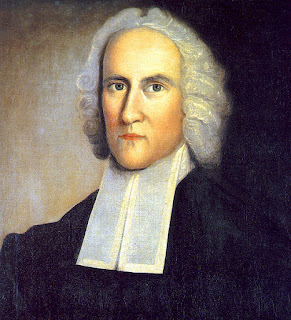
Jonathan Edwards (1703-1758).
For Edwards, his idealism is not meant to displace the commonsense, scientific conception of the universe: "Though we suppose that the existence of the whole material universe is absolutely dependent on idea, yet we may speak in the old way, and as properly and truly as ever." For, "all the natural changes in the universe . . . in a continued series" are commensurate with that completed, virtual series of ideas in the Logos." That is why "divine constitution is the thing which makes truth:" for it includes both an ontic and epistemological correspondence between the actual to the virtual ideas in God. That individual identity of a created thing is not located in itself, be it in an underlying substance or otherwise, need not undermine creaturely integrity For a created thing to be dynamically recreated and reconstituted as singular testifies to its utter poverty of independent being and its radically dependent ontological relation to God. This oneness of the physical universe is, therefore, not an illusion to God or human beings." (184)

Tan's article reminded me of his excellent Fullness Received and Returned: Trinity and Participation in Jonathan Edwards.

Chapter 10 offers James M Arcadi's "Idealism and Participating in the Body of Christ." Assuming Berkeley's idealism, the article's goal is to argue that the model of the Eucharist (which he calls "impanation") the author offers "makes best sense of the conjunction of the commitments to idealism and the corporeal presence of Christ in the Eucharist" (198).

Any Christian theologian faced with the task of interpreting Christ’s utterances at the Last Supper is in for a challenging project. Those sympathetic to idealism and to a corporeal presence interpretation of these utterances are in for an even stiffer challenge. For how could Christ be said to be bodily present in the Eucharist when none of the sensible qualities of his body are presented to the minds of the recipients? This trouble is compounded in corporeal presence theories of the Eucharist that explicitly state that the sensible qualities of Christ’s body are not present in the Eucharist. On an idealistic metaphysical framework, this surely entails that Christ is not bodily present in the Eucharist. Faced with this dilemma, one might be tempted to give up idealism or give up on corporeal presence notions of Christ in the Eucharist. However, I have argued that impanation, and specifically Type-S Impanation, is able to deliver on the corporeal presence of Christ in the Eucharist within an idealist ontology. (210)

The argument in and of itself seems formally valid, and it is very interesting to follow its course assuming (for the sake of argument) one of the two premises, i.e., a doctrine of the corporeal presence of Christ in the Supper (the other premise is idealism). However, since premises are the grounds upon which an argument stands or falls (including when the argument is formally impeccable), and assuming the dilemma is real, one could not feel any need to give up idealism because there is no need to accept a corporeal presence. Arcadi himself says: "If the model I offer is not accepted, I suggest one must give up one of these conjuncts" (198). Personally, I have still to meet a proper biblical and philosophical explanation of how Christ can be fully and truly human and be in any sense corporally or bodily present elsewhere than where his body is. Therefore, I find a corporeal presence dispensable.

Finally, we have chapter 11 with Timo Airaksinen's "Idealistic Ethics and Berkeley’s Good God." The author seeks to show what follows.

Berkeley’s idealistic ethics: one cannot define moral notions and conscience without a reference to the mind and its functions or, in this case, God’s will. He is the ideal model and the measure of the good and the right, or virtue. There are no other adequate models. In other words, it only makes sense to talk about ethics in a theological context. To talk about the good and the right as do the scientifically minded mechanist materialists and supporters of enlightened atheism— or the “free thinkers” of Berkeley’s time— is to miss the indispensable spiritual components of ethical terms. Hence, Berkeley is an ethical idealist in the Platonic sense: his faith in God allows him to define the ethical ideals, or the model principles of moral conduct and the measures of ethical life, in an idealistic fashion. His ethics rests on idealistic metaphysics— it is metaphysically informed as it tracks God. (218)

The paper helps the reader towards that stated direction. Nevertheless, the article leaves the impression to possess an expository and argumentative potential that was not actuated as it could have.


Concluding Remarks

One thing that this volume made me realize even more is that labels, although necessary, can be misleading at times. There are a lot of misconceptions regarding idealism, from simple misunderstandings to grandiose statements regarding idealism's allegedly inexorable slippery slope into full skepticism. I believe that part of the reason for these misconceptions can be partly summarised by using the words of German philosopher Kurt Flasch. Although what follows is related primarily to Medieval theologian and philosopher Meister Eckhart (1260–1328), it can apply to other "influential thinkers" such as Edwards.

"The works and ideas of influential thinkers, because of their rich complexity, seem different to every historical age; they oscillate, unconcerned with how we categorize them. But anyone who starts to work historically looks for order; he needs labels, and so he clings to disciplinary affiliations, intellectual currents, titles. Historical thinking thrives on rebelling against this initial manner of categorizing, classifying, and designating, especially in philosophy, where certain labels—like idealism, realism, and so forth—are almost never used without doing injustice. They drown the individual thinker in currents. Our task here is to try to grasp Eckhart's intellectual world, the private world of a misfit, through his writings; other labels we may bring to the text are dismissible and of no real value, except perhaps for their preparatory and didactic nature as aids to a first approach. Nothing can be inferred from them about Eckhart. At best, they are heuristic tools." ~ Kurt Flasch, Meister Eckhart: Philosopher of Christianity, 14.

In this regard, one of the main benefits I got from the reading of this book was further knowledge and clarity regarding 1) Berkeley's and Edwards respective idealism, and 2) terms (idealist, realist, matterist) and issue at stakes in these often complicated metaphysical debates, which in turn 3) help me to further clear my mind from perplexities and misconceptions regarding theistic idealism.

I also liked that the articles focused on Berkeley's and Edwards' idealism, which I think helped keeping the articles unified.

A book for the discerning reader, I recommend it to the student and to the scholar. It is not only a contribution to Christian theistic idealism, but also to Berkeleyian and Edwardsean studies.


Review copy kindly provided by Bloomsbury.

©

Tuesday, 3 November 2020

Jonathan Edwards' Vision of Reality, by J. J. Bombaro: A Review

Quite straightforwardly, John J. Bombaro's Jonathan Edwards's Vision of Reality: The Relationship of God to the World, Redemption History, and the Reprobate (Eugene, OR: Pickwick Publications, 2012) is a great good, and with no further ado I will tell you why I think that. 

A Brief Synopsis
After a helpful Introduction, Chapters 1-3 do something that is not always done in expositions of Edwards' thought: they extensively examine the nature of Edwards' "new sense" conversion, and the importance that that experience had for the birth and development of his God-centered view of reality. These chapters are very important to realize that the motivation of Edwards' view was not only speculative but also, if not primarily, spiritual and theological. Then the author proceeds by further discussing the structure and ramifications of Edwards' God-centered metaphysics: Edwards' doctrine of being and divine omnipresence (Chapter 4); Edwards' Christian panentheism and his view of God as the end of all things and redemption as the main means to that end (Chapter 5); the necessity to see Edwards' divine dispositionalism within the context of both Edwards' classical view of God's nature and his philosophical idealism, plus helpful corrections of Sang Hyun Lee's errors in interpreting Edwards (Chapter 6); important discussion on Edwards' ontology and idealist epistemology, with concluding remarks on Edwards' doctrine of the Trinity since Edwards shapes his view of man and reality according to the Divine pattern (Chapter 7, which was also helpful to me to understand how Edwards to some degree transcends the idealist-realist distinction since he can be called both, once we posit the necessary qualifications).

Chapters 8 and 9 expound on Edwards theological anthropology and how humans are created to be an image of the Trinity. The chapters also correct Stephen H. Holmes' and Michael McClymond's unnecessary conclusion according to which the reprobate, since they have totally lost God's principles of holiness and righteousness, are therefore dehumanized. They do not consider that there is a distinction between natural and supernatural principles or dispositions (which can be equated to Edwards' distinction between God's natural and spiritual image in man). Edwards maintains that man's natural principles (understanding, will, consciousness, etc.) are what defines humanity, and they have not been lost with the fall (although they have been affected). Man's supernatural principles, however, are not essential but accidental in man (here Edwards' doctrine of self-love comes in), and that is what fallen man has lost entirely. What more interests Edwards, however, is true beauty, and that can be possible only in participation with the Triune God.

Chapters 10 and 11 are, in my opinion, masterful. They further show how Holmes and McClymond err regarding Edwards' anthropology, against the background of a correct view of Edwards' doctrine of man. Moreover,  these chapters try to offer a coherent exposition of Edwards' view of the fall of Adam into sin. Such an account has been often criticized in the literature, but John shows its reasonableness, at least within the context of Edwards' God-centered metaphysics. Chapter 11 also offers some important epistemological considerations regarding what unregenerate and regenerate may perceive about spiritual and natural matters, both in this life and in the afterlife. 

Chapters 12 and 13 present Edwards' view of salvation (both individual salvation and corporative, from individual regeneration to final glorification), together with Edwards' God-centered view of history against the man-centredness of the Enlightenment. These Chapters also refutes Gerald McDermott's and Anri Morimoto's revisionist and universalist readings of Edwards, readings which John rightly says: "Justified talk of Edwards's potential soteriological inclusivism is simply fiction" (p. 24).

The Conclusion lists and discusses the attractiveness and unattractiveness of Edwards' philosophical theology for modern readers. Interestingly enough, for someone like me who is sympathetic to Edwards' view of reality, I find his "unattractiveness" quite attractive. Finally, Appendix A shows the radical differences between Edwards and process theology. Desperate attempts to place Edwards near to process theology are still ongoing (see here, for example), and, by their very nature, they cannot but be characterized by a deep lack of textual evidence coupled with a selectively truncated presentation of Edwards' thought. Appendix B discusses Edwards' view of sufficient and efficacious grace in relation to the pre- and post-lapsarian man.

Christ: The Beginning and the End
The book is heartwarmingly Christological. As a Lutheran scholar and minister, John undoubtedly knows the centrality of the Logos incarnate for Christian wisdom and worldview. Edwards-the-Calvinist' overall theocentric emphases can sometimes lead to believe that he did not give a prominent place to Christ, a conclusion which would be mistaken. For example, see the commentary to Edwards' account of his "new sense" conversion.
"From about that time, I began to have a new kind of apprehensions and ideas of Christ, and the work of redemption, and the glorious way of salvation by him ... Not long after I first began to experience these things ... I was walking there, and looked up on the sky and clouds; there came into my mind, a sweet sense of the glorious majesty and grace of God, that I know not how to express. I seemed to see them both in a sweet conjunction: majesty and meekness joined together: it was a sweet and gentle, and holy majesty; and also a majestic meekness; an awful sweetness; a high, and great, and holy gentleness. After this my sense of divine things gradually increased, and became more and more lively, and had more of that inward sweetness. The appearance of everything was altered: there seemed to be, as it were, a calm, sweet cast, or appearance of divine glory, in almost everything. God's excellency, his wisdom, his purity and love, seemed to appear in everything." ~ WJEO 16:793-794.
John comments as follows. I like how he succinctly touches theology, soteriology, epistemology, and ontology in a few lines.
By Full of Eyes (Chris Powers).
"Christ and redemption are mentioned first because of their relation to special revelation and God's 'end of creation' summarily being accomplished in and through the Son of God. In the Bible God said He would ultimately glorify Himself in the person and work of the Son of God, Jesus Christ. Thus, God's 'end of creation' is the glorification of Himself through the perfect idea or image of Himself, viz. the Son crucified and resurrected. A 'new kind of apprehension of Christ,' therefore, is not categorically different than apprehending God as God. The connection between content, mode, and sensibility of perception first converge on the spiritual sense as the facilitator of right thoughts and affections about God through Christ, or, similarly, God as Savior. Here Edwards' philosophical epistemology and soteriology merge together. Thus, when he writes, 'The first that I remember that ever I found anything of that sort of inward, sweet delight in God and divine things, that I have lived much in since, was on reading those words [from 1 Tim. 1: 17],' we find that these words are the climactic conclusion to a sixteen-verse celebratory discourse on the gospel of Christ. The 'vision' of God as God is mediated by the Spirit as a 'vision' of God through the Christ presented in the pages of the New Testament as the eternal Logos (Divine Word) incarnated. Edwards' theocentrism, we learn, is never without an element of logocentricity: the Word inscripturated serves as the means by which God converts the soul." ~ P. 54.
For other places where John highlights the centrality of Christ in Edwards' system, see also pp. 39, 130-131, 119-120, 252, 274-275.

A disagreement
John claims that according to Edwards, there are irregularities in God's being which are expressed through the reprobate; for example: "God's being possessing a disconcertingly high degree of 'irregularities'" (p. 232). Considering the existence and destiny of the reprobate, according to John there "needs to be an account of the reprobate themselves in relation to God’s prior and necessary dispositions" (quoted from an email exchange). This is because "given Edwards’ view of the end for which God created the world, there are dispositions within God that externalize or make manifest His excellencies. But for this to be consistent with Edwards’ ontology for maximal excellency, an account of the reprobate factor into the dispositional impulses of God" (Ibid.).

I am not convinced that what John claims follows from his own account of Edwards' view of God's dispositional nature. These are some considerations.

Firstly, on p. 174, note 124, John mentions Misc. 950 and 1032 in support of that claim. However, I do not see anywhere Edwards saying what John claims in his book. Moreover, it is one thing to say that there are deformities and irregularities "within God's beautiful matrix" (p. 174, emphasis added), while it is a radically different thing to say that "God's being possessing a disconcertingly high degree of 'irregularities'" (p. 232). John admits that Edwards does not use the terms "irregularities" and "deformities" and that they are never applied to God in Edwards' works. The claim, however, logically follows from Edwards' account of God's communicative nature, according to John. To which I answer with my second point.

Secondly, John himself grants that, for Edwards, human nature is defined according to its natural faculties, and the supernatural faculties are accidental. Therefore, reprobate, both in this life and in hell in the life to come, are and will always be humans. Their existence, therefore, still reflects God's natural attributes (understanding and will). This is their dispositional ontological ground and origin. But what about their eternal condemnation? If the saints' participation in divine glory reflect the perfect communion of the man Jesus Christ with the Logos who indwells him by the Holy Spirit, and, in turn, the perfect blessedness of the Trinity, how do we account for the eternal damnation of the reprobate in the light of divine dispositionalism? 

I do not believe that positing "irregularities" and "deformities" in God's being is necessary to answer that question. As a start, they are not a necessary condition in Edwards' ontological principle according to which the greater the excellency, the greater the complexity ("complexity" is not necessarily a pejorative or negative terms, while "irregularities" and "deformities" are). Furthermore, the reprobate's eternal experience of God's wrath can be accounted for with God's absolute opposition to what is not Himself and to what does not participate in Him through Christ in the Love that is the Holy Spirit. The "irregularities and "deformities" are the reprobates (and the fallen angels, of course, who also are moral, rational beings), so such irregularities and deformities can be placed in God's created matrix, but there is no need to track them back as belonging to God's being. The reprobate existence is the created manifestation of God's disposition of hatred of sin and evil, which is no irregularity of deformity but simply a negative consequence of God's holiness. The irregularity in the disposition's manifestation does not entail irregularity in the disposition itself or in the Disposer. For instance, an unprotected skin burned by the sun argues for no irregularity in the sun but rather in the skin which had no sunscreen (as God's righteousness and the Holy Spirit are not essential to human nature, so the sunscreen is not essential to the human skin). The dispositional account of human nature of the reprobate is maintained, and their hatred for God does not need to be accounted for through "irregularities" in God, because that hatred is "simply" the non-essential expression of a created understanding and will which, although imaging God in the possession of these (essential) faculties, still is deprived of the (accidental) Holy Spirit and, therefore, goes in the opposite direction of true love.

The necessity of an alternative to John's conclusion appears even further if we consider that "irregularities" and "deformities" are relative terms, that is, they need a third term. Irregular and deform with respect to what? To other things, attributes, dispositions in God which are "regular" and "formed"? That would exponentially (and unnecessarily) complicate the picture of Edwards' dispositional view of God, and I doubt that that is what Edwards' system entails with "complexity."

I am sure my alternative needs to be refined significantly. However, John seems to make a jump from God's dispositionality to God's being and nature which, in my view, is not required by Edwards' own account. 

I hope I have not misrepresented John's position (if so, that was certainly not intentional). Anyway, do not take my word for it, since John has my email and I look forward for his rejoinder.

Conclusions
Besides the disagreement I just discussed, Jonathan Edwards' Vision of Reality is a great achievement. John has offered a comprehensive exposition of Edwards' titanic view of all things, a harmonious and coherent symphony where theology and philosophy, natural and special revelation, speculation and spirituality work together to shows Edwards' captivating view of the comprehensiveness of the Triune God.

John lets Edwards speaks of himself. He carefully considers Edwards' historical and intellectual context and reads any Edwardsean argument and proposition in light of Edwards' general system. By doing so, and through careful and comprehensive use of the texts, John has been able to shed light also on issues of Edwards' thought that, although certainly problematic, are too often exaggeratedly considered as unacceptable. Jonathan Edwards' Vision of Reality is a demanding and challenging read, and perhaps it is not suited for the beginners. However, for intermediates and higher, it is required reading.

©

My gratitude to Pickwick Publications for providing me with a review copy.

Sunday, 6 September 2020

Jonathan Edwards on Sin and Holiness

The nature of sin necessarily implies misery. That soul that remains sinful must of a necessity of nature remain miserable, for it is impossible there should be any happiness where such a hateful thing as sin reigns and bears rule. Sin is the most cruel tyrant that ever ruled, seeks nothing but the misery of his subjects; as in the very keeping of God’s commands there is great reward, so in the very breaking of them there is great punishment. Sin is a woeful confusion and dreadful disorder in the soul, whereby everything is put out of place, reason trampled under foot and passion advanced in the room of it, conscience dethroned and abominable lusts reigning. As long as it is so, there will unavoidably be a dreadful confusion and perturbation in the mind; the soul will be full of worry, perplexities, uneasinesses, storms and frights, and thus it must necessarily be to all eternity, except the Spirit of God puts all to rights. So that if it were possible that God should desire to make a wicked man happy while he is wicked, the nature of the thing would not allow of it, but it would be simply and absolutely impossible.

Holiness is a most beautiful, lovely thing. Men are
 apt to drink in strange notions of holiness from their childhood, as if it were a m
elancholy, morose, sour, and unpleasant thing; but there is nothing in it but what is sweet and ravishingly lovely. ‘Tis the highest beauty and amiableness, vastly above all other beauties; ‘tis a divine beauty, makes the soul heavenly and far purer than anything here on earth—this world is like mire and filth and defilement compared to that soul which is sanctified—‘tis of a sweet, lovely, delightful, serene, calm, and still nature. ‘Tis almost too high a beauty for any creature to be adorned with; it makes the soul a little, amiable, and delightful image of the blessed Jehovah. How may angels stand with pleased, delighted, and charmed eyes, and look and look with smiles of pleasure upon that soul that is holy! Christian holiness is above all the heathen virtue, of a more bright and pure nature, more serene, calm, peaceful, and delightsome. What a sweet calmness, what a calm ecstacy, doth it bring to the soul! Of what a meek and humble nature is true holiness; how peaceful and quiet. How doth it change the soul, and make it more pure, more bright, and more excellent than other beings.

 ~ Jonathan Edwards, "The Way of Holiness" (1722). A sermon from Sermons and Discourses: 1720-1723 (WJE Online Vol. 10), 476-480.

Sunday, 26 July 2020

Silence

By Caspar David Friedrich (1774–1840).
From Wikimedia Commons.
If, in observing the present state of the world and life in general, from a Christian point of view one had to say (and from a Christian point of view with complete justification): It is a disease. And if I were a physician and someone asked me "What do you think should be done?" I would answer, "The first thing, the unconditional condition for anything to be done, consequently the very first thing that must be done is: create silence, bring about silence; God’s Word cannot be heard, and if in order to be heard in the hullabaloo it must be shouted deafeningly with noisy instruments, then it is not God’s Word; create silence! Ah, everything is noisy; and just as a strong drink is said to stir the blood, so everything in our day, even the most insignificant project, even the most empty communication, is designed merely to jolt the senses or to stir up the masses, the crowd, the public, noise! And man, this clever fellow, seems to have become sleepless in order to invent ever new instruments to increase noise, to spread noise and insignificance with the greatest possible haste and on the greatest possible scale. Yes, everything is soon turned upside down: communication is indeed soon brought to its lowest point with regard to meaning, and simultaneously the means of communication are indeed brought to their highest with regard to speedy and overall circulation; for what is publicized with such hot haste and, on the other hand, what has greater circulation than-rubbish! Oh, create silence!" 

 ~ Søren Aabye Kierkegaard, For Self-Examination, I, 47-48.

Wednesday, 8 July 2020

A Dostoevskyan Maelstrom


The Double (1846), White Nights (1848), Notes from Underground (1864), The Meek One (1876), and The Dream of a Ridiculous Man (1877). These are the five stories contained in this nice collection. They are some of the shorter works the brilliant Russian writer Fyodor Mikhailovich Dostoevsky (1821–1881). They are phenomenally written stories of alienation from self, others, and God through pride, oversize shame, narcissism, disordered self-consciousness, and utopian ideas. This edition also contains a helpful introduction and handy endnotes aimed at guiding the reader through Dostoevsky's many literary, philosophical, social, and political references.

The Double is the story of a man crippled with shame, and his unrealistic attempts to idealize his own self only make things worse, to the point of driving him to complete alienation and, ultimately, to madness.

In White Nights, an isolated man begins to fall in love with an equally emotionally fragile young woman. A love story with an announced tragic end, since the young woman is already unofficially promised to someone else. Differently from the antiheroes of The Double, Notes from Underground, and The Meek One, White Nights' antiheroes, the White Nights' protagonist does not willfully inflict pain and shame over his loved one. His detachment from reality and mankind, however, ends up hurting both of them.

Notes from Underground is the imaginary diary of a man so clueless of and adverse of the true nature of love and companionship that he cannot even simply conceive them as being nothing but domination and humiliation of the other. In fact, every attempt that he makes to establish a relationship ends either in his own or others' humiliation, or both.

The Meek One is the story of a pawnbroker who believes that, in order to love someone, the other must be forcibly shaped according to his own preconceived and ill-conceived image. He is the kind of person that "is sometimes perfectly ready to plunge the soul they say they love in endless misery if only they can still in some fashion possess it" (C. S. Lewis, The Great Divorce, 115; see, as a contrast, The Four Loves, 62). As he marries a woman much younger than him, he realizes his foolishness only when it is too late.

The Dream of a Ridiculous Man tells the story of an atheist and relativist who (coherently to his worldview) believes that nothing at all matters. Thus, he decides to take his own life. However, a fantastic dream leads him to a radical conversion and change of perspective.

Together, these stories are a slow and inexorable psychological and spiritual maelstrom into some of the most intricate labyrinths of the misery of mankind. These works tell us of some of the direst consequences of mankind's fallen state. Although the narrations are focused on specific individuals, references to mankind in general are also present. Perhaps the following passage from the last chapter of The Dream of a Ridiculous Man (pp. 380-381) offers the overarching metaphysical setting and general interpretative key of all the stories by Dostoevsky mentioned here. Perhaps, without its context, this passage is not fully comprehensible. Perhaps I have not said enough to favor a full comprehension. Well, these are two more reasons for reading them by yourself.
Then science appeared. As they became wicked they began talking of brotherhood and humanitarianism, and understood those ideas. As they became criminal, they invented justice and drew up whole legal codes in order to observe it, and to ensure their being kept, set up a guillotine. They hardly remembered what they had lost, in fact refused to believe that they had ever been happy and innocent. They even laughed at the possibility o this happiness in the past, and called it a dream. They could not even imagine it in definite form and shape, but, strange and wonderful to relate, though they lost all faith in their past happiness and called it a legend, they so longed to be happy and innocent once more that they succumbed to this desire like children, made an idol of it, set up temples and worshipped their own idea, their own desire; though at the same time they fully believed that it was unattainable and could not be realised, yet they bowed down to it and adored it with tears! Nevertheless, if it could have happened that they had returned to the innocent and happy condition which they had lost, and if someone had shown it to them again and had asked them whether they wanted to go back to it, they would certainly have refused. They answered me: "We may be deceitful, wicked and unjust, we know it and weep over it, we grieve over it; we torment and punish ourselves more perhaps than that merciful Judge Who will judge us and whose Name we know not. But we have science, and by the means of it we shall find the truth and we shall arrive at it consciously. Knowledge is higher than feeling, the consciousness of life is higher than life. Science will give us wisdom, wisdom will reveal the laws, and the knowledge of the laws of happiness is higher than happiness." That is what they said, and after saying such things everyone began to love himself better than anyone else, and indeed they could not do otherwise. All became so jealous of the rights of their own personality that they did their very utmost to curtail and destroy them in others, and made that the chief thing in their lives. Slavery followed, even voluntary slavery; the weak eagerly submitted to the strong, on condition that the latter aided them to subdue the still weaker. Then there were saints who came to these people, weeping, and talked to them of their pride, of their loss of harmony and due proportion, of their loss of shame. They were laughed at or pelted with stones. Holy blood was shed on the threshold of the temples. Then there arose men who began to think how to bring all people together again, so that everybody, while still loving himself best of all, might not interfere with others, and all might live together in something like a harmonious society. Regular wars sprang up over this idea. All the combatants at the same time firmly believed that science, wisdom and the instinct of self-preservation would force men at last to unite into a harmonious and rational society; and so, meanwhile, to hasten matters, "the wise" endeavoured to exterminate as rapidly as possible all who were "not wise" and did not understand their idea, that the latter might not hinder its triumph. But the instinct of self-preservation grew rapidly weaker; there arose men, haughty and sensual, who demanded all or nothing. In order to obtain everything they resorted to crime, and if they did not succeed--to suicide. There arose religions with a cult of non-existence and self-destruction for the sake of the everlasting peace of annihilation. At last these people grew weary of their meaningless toil, and signs of suffering came into their faces, and then they proclaimed that suffering was a beauty, for in suffering alone was there meaning.

©